Decking Boards
Strong, pressure-treated timber boards ready to lay. Built to last through all seasons and feel solid underfoot.
Decking Joists
The right joists make all the difference. These C24-graded lengths give your deck the strength it needs underneath, even on uneven or soggy ground.
Decking Joists
Add a neat finish and a bit of safety. These timber rails suit most deck sizes and help frame the space without making it feel closed in.
Decking Accessories
The little bits matter. Get the right screws and fixings to ensure your boards stay in place and remain sturdy after years of exposure to sun and rain.
Planning a new timber deck? Use our free Decking Calculator. Enter your deck size and we'll work out the boards, joists and screws you need, with today's prices, and add it all to your basket in one go. Try the Decking Calculator
A well-designed deck can change the way you use your garden. Somewhere to sit in the sun. A dry path across the grass. A place to drag the BBQ when the weather holds. But it only works if the materials are up to the job. We stock solid timber boards and strong joists, all pressure-treated and ready to go.
You don’t need to know everything before you start, as we’ve helped plenty of people who came in with a rough idea and left ready to build their dream decking. If that’s you, give us a call or send us an email.
30 Item(s)
-
Q-Deck Canterbury Decking (Smooth & Grooved) 4.8 Meter 38 x 150mm
Excl. VAT: £14.58 4.8m Incl. VAT: £17.49 4.8m -
Q-Deck Canterbury Decking (Smooth & Grooved) 3.6 Meter 38 x 150mm
Excl. VAT: £12.24 Incl. VAT: £14.69 -
Q-Deck Winchester Decking | 4.8 Meter 38 x 150mm
Excl. VAT: £15.21 2 Week Lead Time Incl. VAT: £18.25 2 Week Lead Time -
Q-Deck Winchester Decking | 3.6 Meter 38 x 150mm
Excl. VAT: £11.41 2 Week Lead Time Incl. VAT: £13.69 2 Week Lead Time -
Q-Deck York Decking | 4.8 Meter 38 x 120mm
Excl. VAT: £15.21 2 Week Lead Time Incl. VAT: £18.25 2 Week Lead Time -
Q-Deck York Decking | 3.6 Meter 38 x 120mm
Excl. VAT: £11.41 2 Week Lead Time Incl. VAT: £13.69 2 Week Lead Time -
4x2 Treated Timber | 100mm x 47mm | 3600mm | 3.6 meters | C24 grade
Excl. VAT: £7.17 Incl. VAT: £8.60 As low as: £7.74 -
4x2 Treated Timber | 100mm x 47mm | 4800mm | 4.8 Meters | C24 grade
Excl. VAT: £9.56 Incl. VAT: £11.47 As low as: £10.38 -
4x2 Treated Timber | 100mm x 47mm | 2400mm | 2.4 meters | C24 grade
Excl. VAT: £4.78 Incl. VAT: £5.73 As low as: £5.16 -
Sale
4x2 Treated Timber | 100mm x 47mm | 4200mm | 4.2 Meters | C24 grade
Regular Price: £10.00
Sale Price Excl. VAT: £7.73 Incl. VAT: £9.28
As low as: £9.03 -
4x2 Treated Timber | 100mm x 47mm | 3000mm | 3.0 meters | C24 grade
Excl. VAT: £5.98 Incl. VAT: £7.17 As low as: £6.45 -
4.5mm x 65mm | Timco C2 Decking Timber Screw | Countersunk | 1000 Tub
Excl. VAT: £24.16 Trade Tub Incl. VAT: £28.99 Trade Tub -
4.5mm x 60 | TIMCO Decking Screw Industry Pack | 1000 Box
Excl. VAT: £19.35 Trade Pack Incl. VAT: £23.22 Trade Pack -
4.5mm x 60 | TIMCO Decking Screw Industry Pack | 1500 Tub
Excl. VAT: £29.15 Trade Pack Incl. VAT: £34.98 Trade Pack -
C2 Decking-Fix Premium Collated Decking Screws | SQ | Countersunk | Exterior | Green | 500 Box
Excl. VAT: £17.50 Incl. VAT: £21.00Out of stock
30 Item(s)
What You Need To Know About Decking
Before you start building your new deck, it’s worth taking five minutes to think it through. Not just the boards you walk on, but the stuff that keeps it solid. The frame, the fixings, the timber itself. We’ve helped people who were halfway through and realised they’d missed something. If you want to avoid that, read on.
Not All Timber Decking Is the Same
You can find decking boards in all sorts of places, and you might think they all look the same. You will find that there’s a big gap between the decking that lasts and the decking that lets you down after a few years. Decking boards can easily twist out of shape or start to splinter after a bit of bad weather, and this isn’t always easy to notice when you’re just standing in a yard looking at a stack.
We only stock pressure-treated timber, built for life in the British climate. Some boards are smooth all over, while others have grooves on one face for added grip when it’s damp. You can lay them either way, depending on what suits your space. We’ve used Q-Deck plenty of times on our own jobs and rate it because it’s reliable, well-finished, and doesn’t surprise you with hidden knots or rough patches halfway through the build.
In our experience, spending a little more up front saves a lot of trouble later. If you’re unsure what to choose, please call in to one of our depots (or email us) with a photo or a rough plan, and we’ll help you select the best option.
Fixings and Accessories You Actually Need
If the fixings aren’t right, the rest of the job doesn’t stand a chance. We’ve seen people spend good money on boards, only to throw them all together with whatever screws were lying around and the decking fell apart 6 months later.
Decking screws are the ideal choice, as they are specifically designed for the job. They’re sharper, they pull the boards tight, and they won’t shear off when the timber moves with the weather. We also stock brackets and clips to help hold the frame square.
In our experience, the accessories are the part that people forget about. But when something gives way underfoot or starts lifting at the edge, it’s always the fixings that get the blame, so it’s best to get them right the first time.
Planning Your Decking Build
Start with a proper measure-up and don’t just guess it by eye. You’ll want to know the full width and length of the space, as well as how it fits with the rest of the garden. Consider factors such as sunlight or the slope of your garden. A straight rectangle might be easier to build, but it doesn’t always work with the way people actually use the space.
Once you’ve got that sorted, check a few key things:
- Have you left enough room for trim, edging, or a step if needed?
- Is the ground level, or will you need to build it up in parts?
- Will the board lengths fit neatly, or do you plan to cut around awkward corners?
- Will anything underneath cause problems, like a drain or a slope that collects water?
Take a Look at our How To Look After your Decking Guide - Click Here
Contact Us
Got any questions? Or need advice on what Decking you need? Don’t worry - we’re here to help. We know Decking inside out.
Chat With Our Team - We’re real people who actually enjoy talking about fencing (yes, really). If you need recommendations, installation tips, or help with an order, then reach out, and we will help.
Delivery Options - We offer fast, reliable delivery straight to your door, We use our own fleet of truck to assure you product gets to you in perfect condition.
Visit us - Based in Northfleet, Kent and Catford in London we’re ideally placed for deliveries across London Kent, Essex and beyond.
Call Us
- Kent - 01322 787 312
- London - 0208 698 4064
Email us - Get in touch via our website contact form.
WhatsApp us - We are only a text message away.
No matter what you need, we’ll make sure you get the right products at the right price.
Many people think the ridges are there to prevent slipping; however, they’re actually there to make the decking last longer. When installed with the ridges facing down, the airflow around the wood increases, reducing the risk of mould building up.
When the decking is installed with the ridges facing up, moisture gets trapped in the grooves and can make the decking deteriorate faster!
In most situations, no. Decking is typically considered a ‘permitted development,’ so no planning permission is needed.
There are a couple of exceptions though:
· If the decking is over 30cm above the ground
· The decking covers over 50% of the garden area (alongside other extensions and outbuildings)
· The decking is being built past the front wall of your property
There are also further requirements that your decking installation needs to meet if you live in a conservation area or close to a highway.
If in doubt, speak to your local council before you go ahead with installing your decking.
There are a wide range of woods you can use, including cedar, redwood, and mahogany.
However, if you’re looking for a sustainable option, we recommend FSC-certified decking boards manufactured from fast-growing woods. All the decking boards we supply are FSC-certified.
Whichever wood you decide on, it’s important that you choose treated timber. Often referred to as pressure-treated timber, this wood has been treated with chemicals that protect against rot, fungi, and termites. This extends the life of your decking by a considerable amount.
High-quality treated timber decking will last a long time when properly installed, but here are some handy tips for extending the life of your wooden decking further.
· Sweep and rinse your decking once a week to get rid of leaves, dirt, pollen, and other debris
· Check regularly for mould and cracks – replacing one board is easier than the entire decking!
· Apply an oil or stain to protect your decking against rain, sun, and snow. We recommend you leave your new decking for six months before you treat it, so the pre-treatment erodes awayYes all our decking is pressure treated to uc3
Yes we have a warehouse and showroom in Northfleet In Kent and also in Catfort London
- DELIVERY AREA
- DECKING FRAME GUIDE
- DECKING CALCULATOR
London
- DA5 Bexley
- DA6, DA7 Bexleyheath
- DA8, DA18 Erith
- DA14, DA15 Sidcup
- DA16 Welling
- DA17 Belvedere
- BR1 Bromley
- BR2 Bromley
- BR5 St Mary Cray
- BR6 Orpington
- BR7 Chislehurst
- BR8 Swanley
- CR Croydon
- SE1 Lambeth
- SE2 Abbey Wood
- SE3 Blackheath
- SE4 Brockley
- SE5 Camberwell
- SE6 Catford
- SE7 Charlton
- SE8 Depford
- SE9 Eltham
- SE10 Greenwich
- SE11 Kennington
- SE12 Lee
- SE13 Hithergreen
- SE14 New Cross
- SE15 Peckham
- SE16 Rotherhithe
- SE17 Walworth
- SE18 Woolwich
- SE19 Norwood
- SE20 Crystal Palace
- SE21 Dulwich
- SE22 East Dulwich
- SE23 Forest Hill
- SE24 Herne Hill
- SE25 South Norwood
- SE26 Sydenham
- SE27 West Norwood
- SE28 Thamesmead
- We deliver to all South West London Post codes
South West London
London
East London
- E1 Whitechaple
- E1c Wapping
- E2 Bethnal Green
- E3 Bromley by bow
- E4 Chingford
- E5 Leyton
- E6 Beckton
- E7 Forest Gate
- E8 Hackney
- E9 Homerton
- E10 Leyton
- E11 Leytonstone
- E12 Manor Park
- E13 Plaistow
- E14 Canary Wharf
- E15 Stratford
- E16 Canning Town
- E17 Walthamstow
- E18 Woodford
- E20 Olympic Park
North London
- We deliver to all North London Post codes
West London
- We deliver to all West London Post codes
Kent
- DA1 Crayford
- DA1 DA2 Dartford
- DA3 Longfield
- DA13 Meopham
- DA13 Istead Rise
- DA9 Greenhithe
- DA10 Swanscombe
- DA11, Northfleet
- DA12 DA13 Gravesend
- ME1 ME2 ME3 Rochester
- ME4 ME5 Chatham
- ME6 Snodland
- ME7 ME8 Gillingham
- ME9 ME10 Sittingbourne
- ME11 Queensborough
- ME12 Sheerness
- ME13 Faversham
- ME14 ME15 Maidstone
- ME16 ME17 ME18 Maidstone
- ME19 West Malling
- ME20 Aylesford
- TN15 West Kingsdown
- TN13 Sevenoaks
- TN1 TN2 TN3TN4 Tunbridge Wells
- TN5 Wadhurst
- TN9 TN10 TN11 TN12 Tonbridge
- TN13 TN15 TN15 Sevenoaks
- TN16 Westerham
- TN17 TN18 Cranbrook
- TN23 TN24 TN25 TN26 TN27 Ashford
- CT1 CT2 CT3 CT4 Canterbury
- CT5 Whitstable
- CT6 Hern Bay
- CT7 Birchington
- CT8 Westgate on sea
- CT9 Margate
- CT10 Broadstairs
- CT11 CT12 Ramsgate
- CT13 Sandwitch
- CT14 Deal
- CT15 CT16 CT17 Dover
- CT18 CT19 CT20 Folkstone
- CT21 Hythe
Essex
- RM1 RM2 RM3 RM4 Romford
- RM5 RM6 RM7 Romford
- RM8 RM9 RM10 Dagenham
- RM11 RM12 Hornchurch
- RM13 Rainham
- RM14 Upminster
- RM15 South Ockendon
- RM16 RM17
- RM18 Tilbury
- RM19 Purfleet
- RM20 Grays
- IG1 IG2 IG3 IG4 IG5 IG6 Ilford
- IG11 Barking
- SS1 SS2 SS3 SS4 Southend
- SS5 Hockley
- SS6 Rayleigh
- SS7 Benfleet
- SS8 Canvey Island
- SS9 Leigh on sea
- SS11 SS12 Wickford
- SS13 SS14 SS15 SS16 Basildon
- SS17 Stanford -Le-Hope
- CM1 CM2 CM3 Chelmsford
- CM4 Ingatesone
- CM5 Ongar
- CM11 CM12 Billericay
- CM14 CM14 CM15 Brentwood
Surry
- Twickenham TW Postcodes
- Kt Postcodes
- Redhill RH Postcodes
Zone 1
- RH1 RH2 RH3 RH4 RH8
Zone 2
- RH5 RH6 RH7 RH10 RH11 RH12 RH18 RH19
Zone 3
- RH13 RH14 RH15 RH16 RH17 RH20
- Guildford GU Post Postcodes
Zone 1
- GU15 GU16 GU17 GU18 GU19 GU20 GU21 GU22 GU23 GU24 GU25 GU46 GU47 £120
Zone 2
- GU1 GU2 GU3 GU4 GU5 GU6 GU7 GU8 GU9 GU10 GU11 GU12 GU14 GU51 GU52
Zone 3
- GU26 GU27 GU28 GU29 GU30 GU31 GU32 GU33 GU34 GU35
New Banner
- Hertfordshire
- EN Postcodes
- WD Postcodes
- AL6 AL7 AL9
- SG12 SG13 SG14
- HA Postcodes
- UB Postcodes
- DA5 Bexley
Decking Frame Guide
We recommend beams are constructed from two 47 x 100mm deck joists and are placed at maximum centres of 400mm.
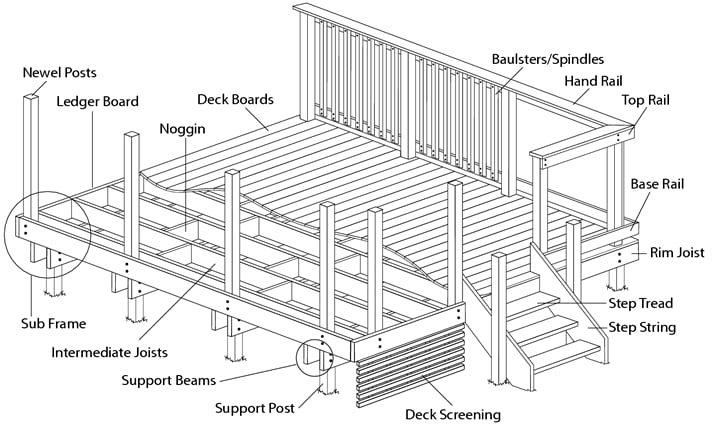
Joist and Deck Board Spacing Guidance
G&G Decking Calculator